Mixed-Methods Research · Behavioral Simulation
Ethical Decision-Making Under MVP Constraints
• Investigated what UX practitioners actually do and not what they say they'd do when ethics and deadlines collide under MVP-style resource pressure. • 20 practitioners (grouped between startups and corporates, India and UK) worked through a two-phase mixed-methods study: a behavioral simulation where they made real feature trade-offs under a time/budget crunch, followed by a stimulated-recall interview where they reviewed their own decisions and explained their reasoning. • This design was built specifically to close the "say-do gap" since self-reported ethics research only captures what people believe they'd do, not what they actually do under pressure
Starting Point
My curiosity was simple: how do UX designers make ethical decisions when they're under corporate pressure?
Every UX practitioner has been in that meeting. The one where resources and deadlines are cut short. Where the edge case user gets deprioritized. Where someone says "we'll fix it in v2," and everyone in the room knows they won't.
What's less understood is what actually happens inside that moment. How practitioners reason through it, what it costs them, and what they quietly do about it when official channels fail.
HCI ethics literature offers frameworks and principles, Value Sensitive Design, Human-Centered Design, professional codes of conduct. What it offers very little on is ethics as a lived, real-time experience under organizational pressure. This research set out to close that gap, not by asking practitioners what they'd do in the abstract, but by studying what they actually do when the pressure is real.
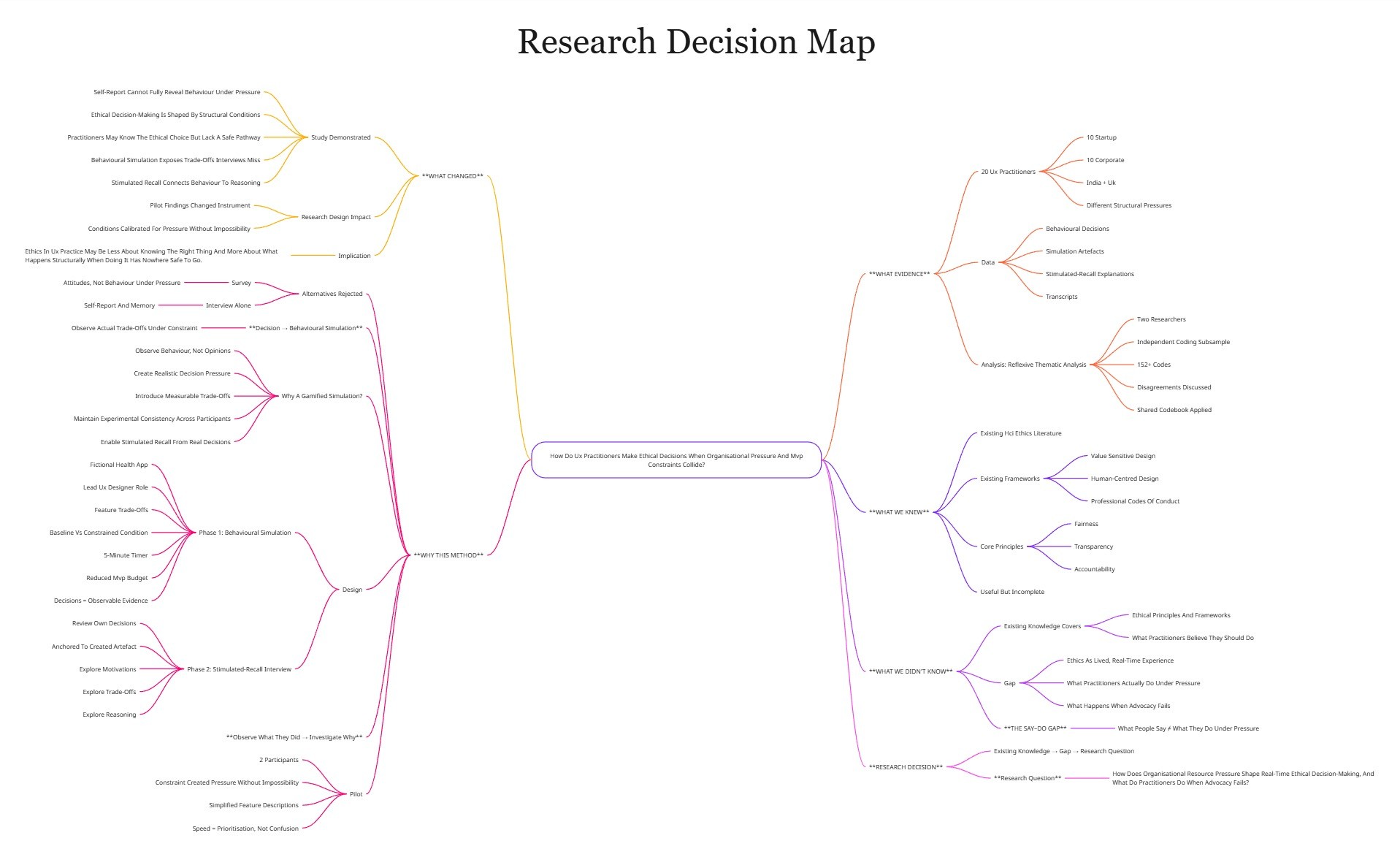
How does organizational resource pressure shape real-time ethical decision-making in UX practice, and what do practitioners do when advocacy fails?
The Say-do Gap
UX practitioners describe what they believe they should do, not what they do under pressure. This "Say-Do" gap is well documented in usability research generally, and it's just as true when the subject is a practitioner's own moral behavior rather than a user's.
That's what shaped the study. Instead of asking people about their ethics, I wanted to observe the say-do gap directly.
The Question → The Method → Why
The study connects what people did to why they did it
I needed to see what practitioners did under real constraint, not what they imagined they'd do. That ruled out a survey and even ruled out interviews alone. So the study was built in two phases.
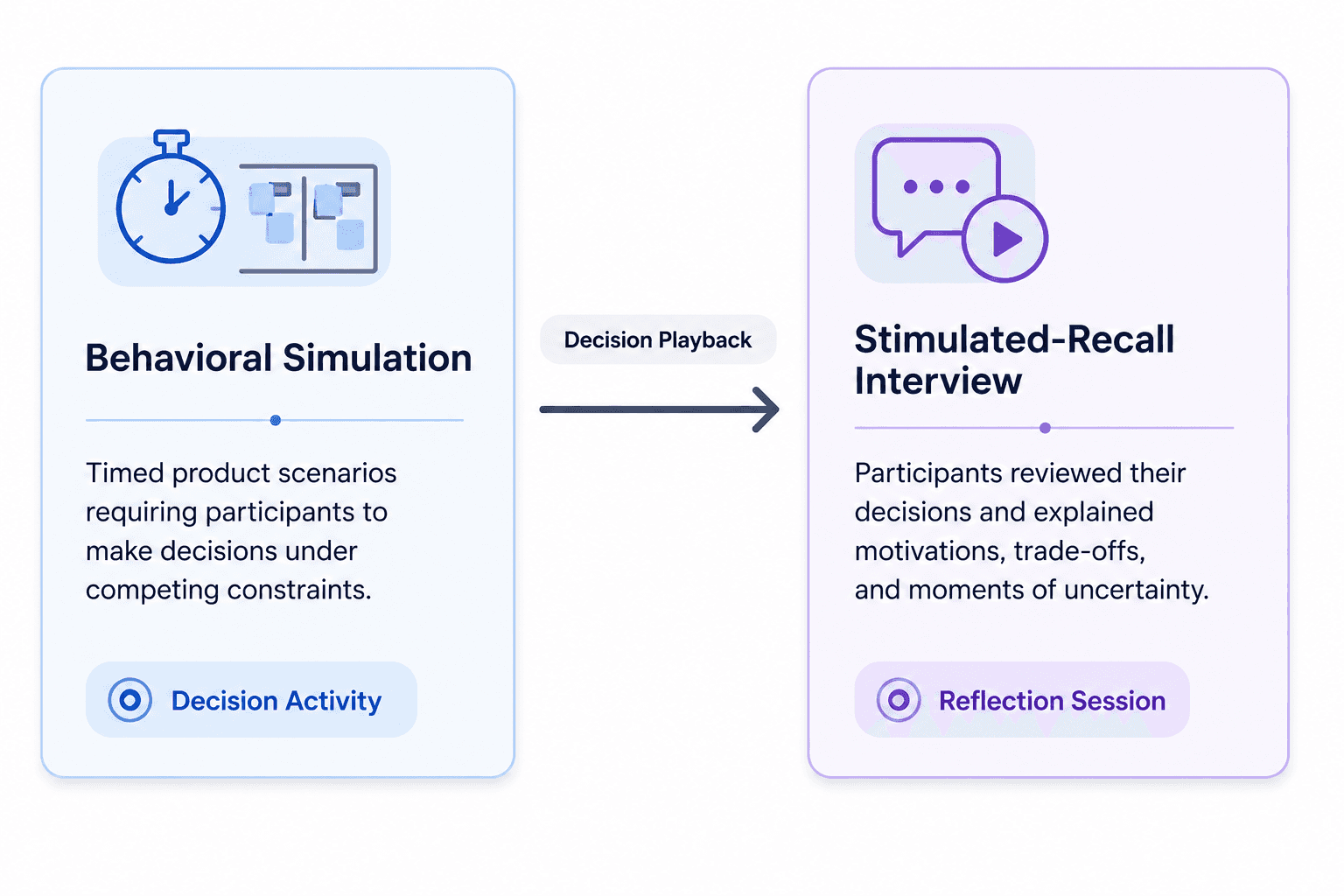
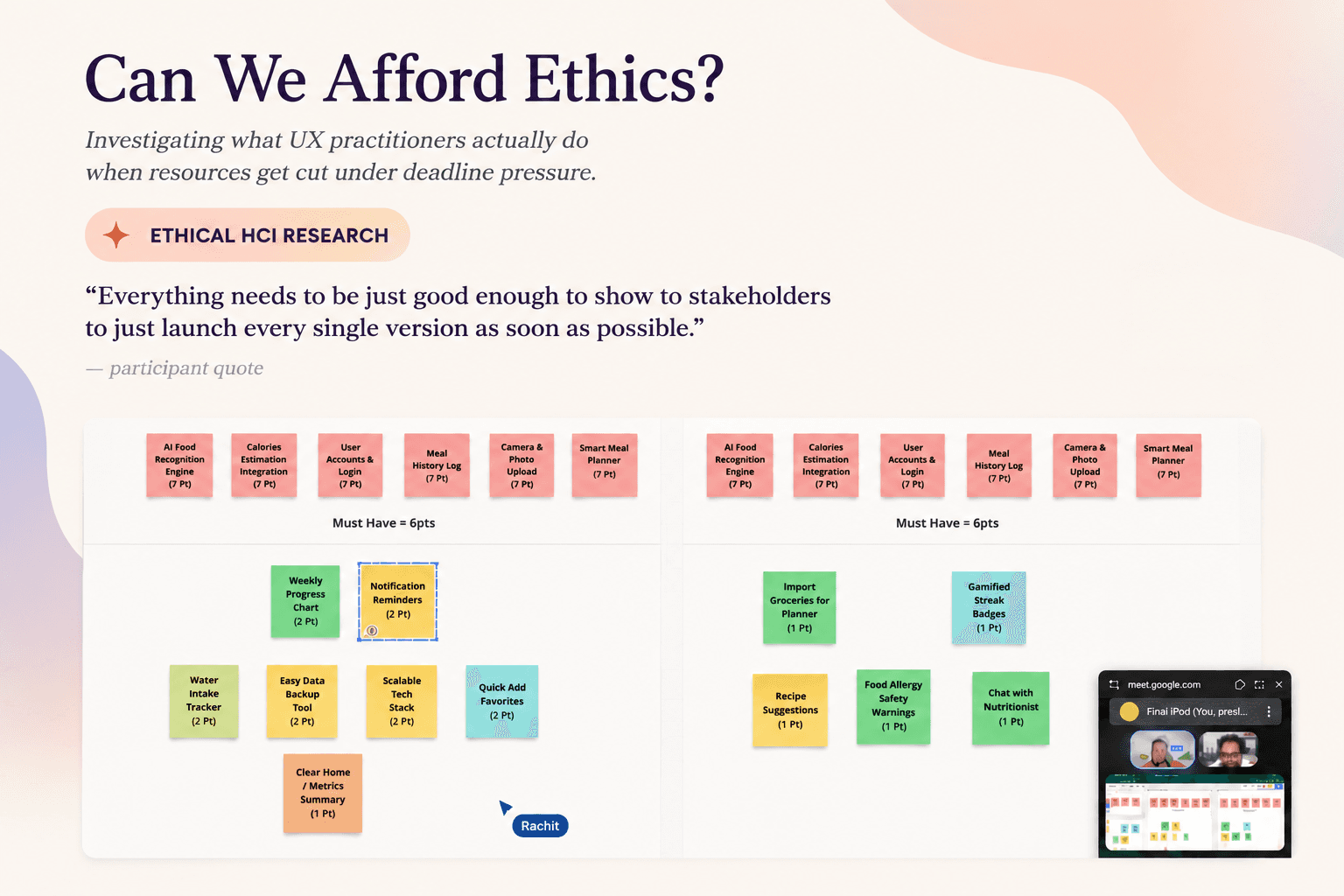
Phase 1 was a behavioral simulation. Participants took on the role of lead UX designer for a fictional health app and worked inside a structured product-design task, first under realistic conditions, then again under a hard time and resource constraint. The task asked them to make real feature trade-offs, not describe hypothetical ones.
Phase 2 was a stimulated-recall interview. After the simulation, participants reviewed their own decisions on the board with me and talked through why they'd made them. This is what let the study connect what people did to why they did it, without relying on memory alone or self-report from the start.
The Pilot
Before running the full study, I piloted the instrument with two participants specifically to test whether the time constraint was tight enough to create real pressure without making the task impossible to complete. That pilot changed how the feature descriptions were written, simplifying them so speed reflected prioritization under pressure, not confusion about the task itself.
Why a simulation instead of interviews alone? Self-report on ethical behavior is notoriously unreliable, people report the version of themselves they believe is correct. A simulation under real constraint gets closer to actual behavior because it gives you something to observe, not just something to take at face value.
Why stimulated recall rather than a standard debrief? Reviewing the board together, rather than asking participants to describe their reasoning from memory, meant their account was anchored to an artifact they'd actually produced, not a reconstructed narrative.
Proof of Process
The simulation environment itself was part of the research design.
Participants built their product on one board with realistic resources and no time pressure, then transferred their work to a second, deliberately blank canvas under a 5-minute timer and a reduced budget for the MVP. That blank canvas was intentional. Moving into an unscaffolded space under pressure was meant to physically echo what a real project reset feels like, stripped of the organization and comfort of the first round.
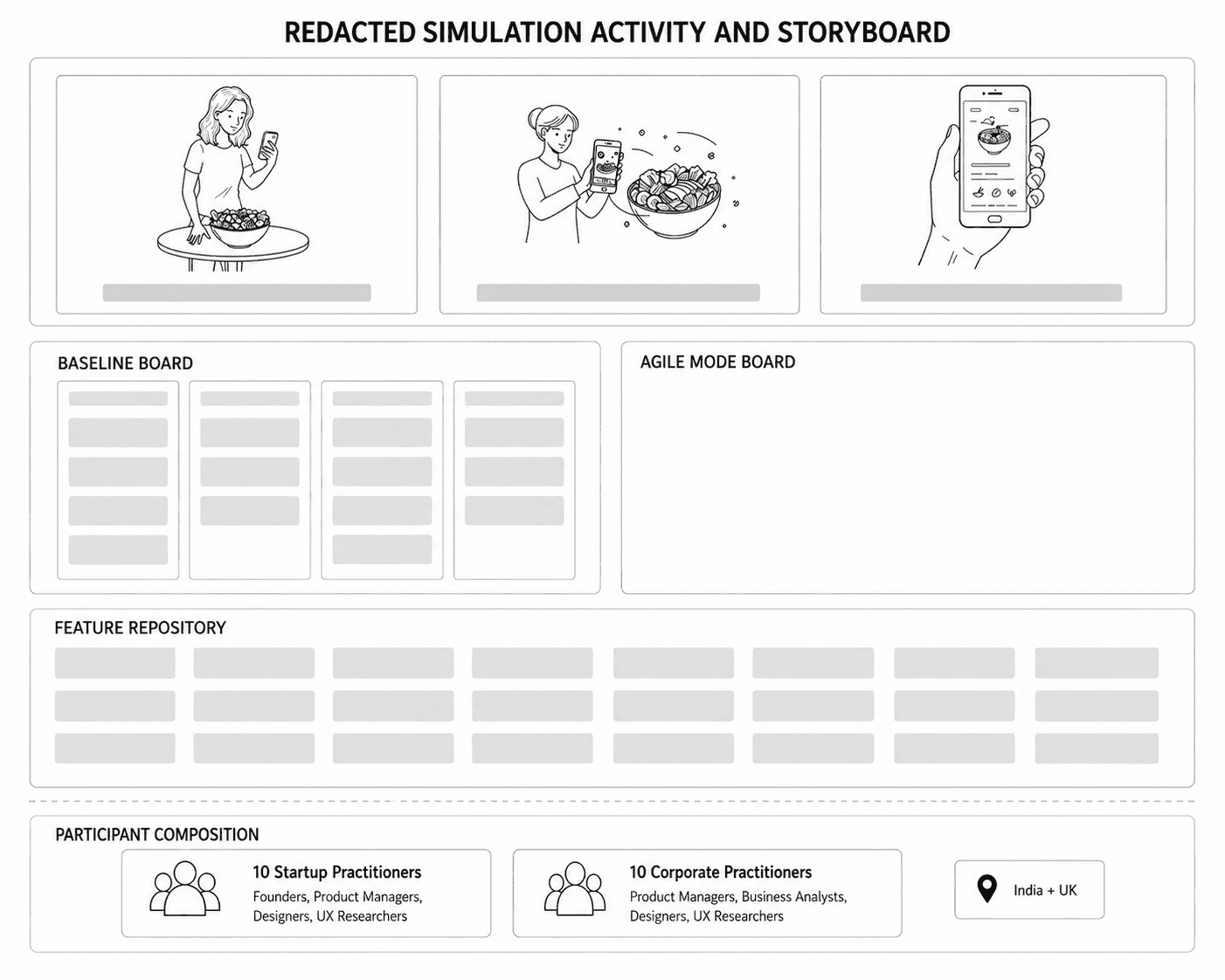
Twenty UX practitioners took part, split evenly between early-stage startup environments and established mid-to-large companies, based across India and the UK. That split was deliberate. Structural pressure looks different depending on where you sit in an organization, and I wanted the study to reflect that range rather than one context.
Every participant gave informed consent, and the study's true intent was temporarily withheld during the simulation itself, disclosed immediately afterward in a full debrief, with the right to withdraw their data. Nobody exercised that right.
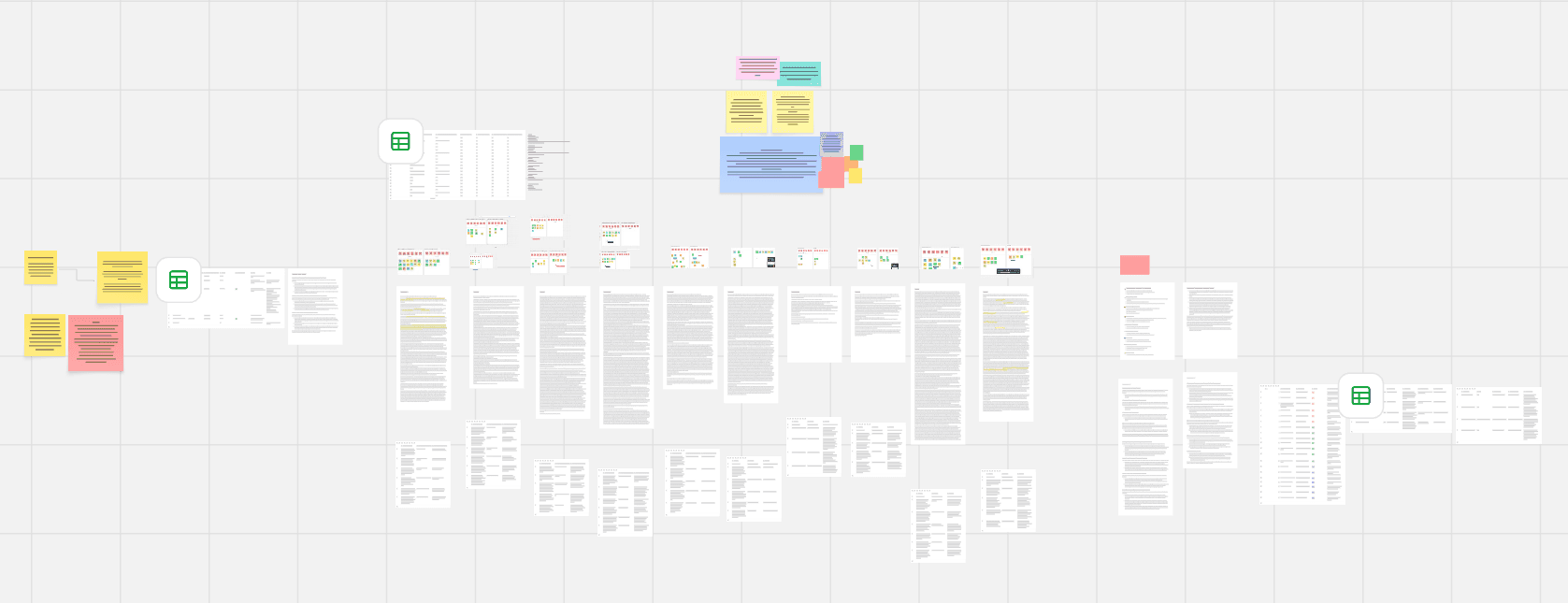
Transcripts were analyzed using Reflexive Thematic Analysis. Two researchers independently coded a subsample of the sessions first, generating well over a 152 codes between us, then worked through the places we disagreed, not to force consensus, but to sharpen the boundaries of what each code was actually capturing. That shared codebook was then applied across the rest of the transcripts.
What This Means
Even before the findings are public, the study's design points to a few things worth sitting with:
Self-report cannot tell us what people do under pressure, only what they believe they'd do. If we want to understand ethical behavior in a workplace, we have to create conditions close enough to real pressure to observe it directly, not ask about it after the fact.
Practitioners are rarely the actual bottleneck we assume they are. The more useful question usually isn't "do they know the right thing to do," it's "what happens structurally when doing it has nowhere safe to go."
A simulation is only as honest as its blind spots. Concealing the study's ethical focus until after the task was over wasn't a trick, it was the only way to get behavior instead of performance.
Reflections
Ethics in UX practice isn't usually a knowledge problem
Going in, I expected the hardest part of this study to be recruitment, twenty practitioners willing to sit through a real product simulation is a genuine ask. What turned out to be harder, and more interesting, was building pressure that felt real without being unethical to induce. The pilot taught me that constraint has to be tight enough to matter and loose enough to still let people make a genuine choice, and calibrating that line took more iteration than I expected.
There's a lot more behind this than a scroll can hold. If you want the deeper cut, I'm one email away.
ux.megha@gmail.com


